

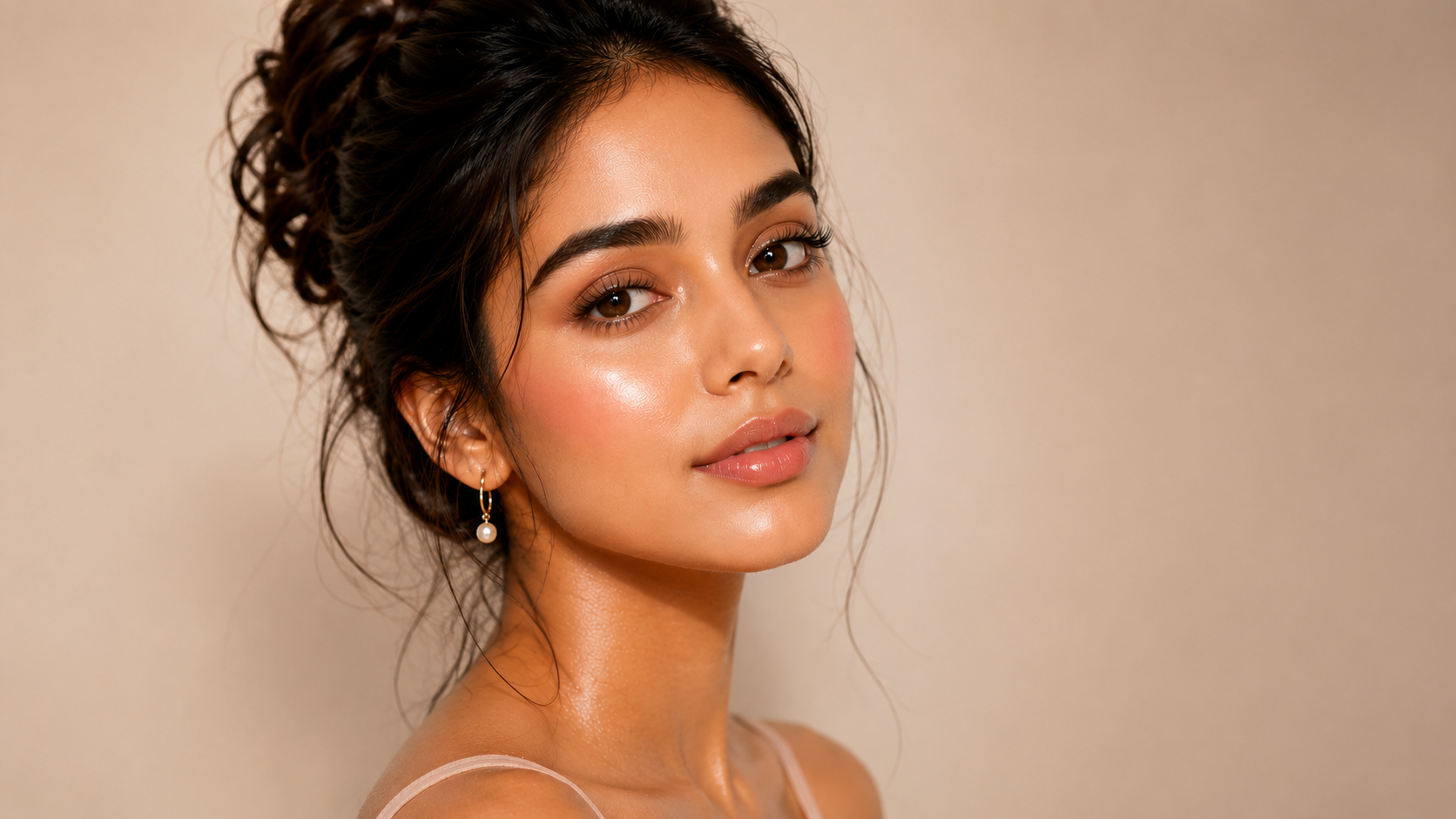
Have you ever noticed your makeup looking flat and dull by afternoon, even though it looked fine in the morning? That usually isn't about the products you're using. It's about the "finish" meaning, how your makeup looks on the skin. If your makeup looks flat and powdery, that means you're using matte makeup products, when your skin might actually look better with a glow.
That glow is called a dewy makeup look. In simple words, it means your skin looks soft, fresh, and naturally glowing like healthy skin, not shiny or oily skin. This look is achieved by using hydrating (moisture-rich) products instead of heavy powders. It suits Indian skin tones especially well, since most Indian skin has a warm undertone, and warm tones tend to glow beautifully.
In this blog, we'll explain what a dewy look really means, how to create it step by step, which products work best, and the common mistakes people make while trying to achieve it.
What Is a Dewy Makeup Finish?
Think of the glow you have right after a facial, not sweaty, not shiny, just healthy and hydrated. That's the target. A dewy finish is achieved by using liquid and cream products such as liquid highlighters, luminous foundations, and hydrating primers. These products catch the light instead of absorbing it.
While matte does the opposite. It soaks up light and smooths everything into one flat plane. Dewy makeup keeps texture and dimension; light bounces off the cheekbones, the bridge of the nose, the brow bone and that's what reads as "glowing" rather than just "shiny."
Why Dewy Makeup Look Work So Well for Indian Skin?
This isn't just a trend thing. There's an actual reason dewy makeup and Indian skin go together so well.
Undertones Matter More Than People Realize
A lot of Indian skin tones, wheatish, olive, and deep brown carry warm or golden undertones. Warm undertones reflect gold and amber light beautifully. A matte finish flattens the facial features and, to be honest, can make the skin look a bit ashy or dull; additionally, the face lacks depth or dimension, especially when a photo is taken with flash.
The Oily Skin Worry (And Why It's Overblown)
Almost everyone has two concerns about dewy makeup: "won't it make me look oily?" and "what about the humidity?" Fair questions. But the answer isn't to avoid dewy makeup; it's to place the glow correctly. Concentrate it on the high points of the face instead of applying it everywhere, and oily skin does just fine with this look.
Humidity is a slightly different beast — it breaks products down faster regardless of skin type, so technique matters more than what you were born with.
It Photographs Better, Too
Because warm and deep undertones already carry gold, amber, and red naturally, a dewy finish just amplifies what's already there instead of covering it up. That's a big part of why dewy makeup tends to photograph better on Indian skin than a heavy matte base, which can look chalky the second a flash goes off.
How to Get the Dewy Makeup Look?
Step 1: It Starts With Skin, Not Makeup
Here's the part nobody wants to hear: a dewy look is mostly skincare. Highlighter cannot fix dehydrated skin, it just sits on top and looks patchy. So before any base product goes on:
- Cleanse, then apply a hydrating serum. Hyaluronic acid is the easy default.
- Follow with a lightweight, non-comedogenic moisturizer and actually let it sink in — don't rush this. Something like the Day & Night 24 Hours Cream works well here.
- Use a hydrating primer. This is the step almost everyone skips, and it's usually the difference between a glow that lasts and one that's gone by noon.
If you deal with more oil than dryness, it's worth reading our piece on oil control primers for sweat-proof makeup — you can still get a dewy effect while managing shine in the T-zone.
Step 2: Pick a Base That's Built for This
Not every foundation is meant to glow. Check the label; if on the product mentioned words like "luminous," "radiant," or "hydrating" are what you want. Anything that says "matte" or "oil-control" is fighting against you here. Tinted moisturizers and satin-finish liquid foundations both work, and options like the Face It Foundation or Fluid Foundation No Transfer build up without sitting heavy.
Apply with fingers or a damp sponge, not a brush. Brushes tend to apply more product and blur that natural, skin-like texture you're going for.
And if under-eyes are looking tired or patchy under a dewy base, our best concealer for dark circles guide is worth a look — brightening without going cakey is its own small art.
Step 3: Highlighter Goes on the High Points Only
This is where the actual "dew" comes from. A cream or liquid highlighter on:
- The tops of the cheekbones
- Down the bridge and tip of the nose
- The cupid's bow
- Inner corners of the eyes
- Collarbone, if it's visible
That's it. Not the whole face. The second you go past these spots, it stops looking like glowing skin and starts looking like you forgot to blot.
Step 4: Set Only Where You Need To
People get this step wrong constantly. A light dusting of setting powder is fine but only in the T-zone, or wherever you tend to get oily first. Leave the cheeks, under-eyes, and anywhere you put highlighter alone. Then finish with a hydrating setting spray, not a mattifying one, or you'll undo everything you just did.
Products Worth Actually Trying
Foundation
Look for "glow," "luminous," or "radiant" on the bottle. You can browse the foundation collection to compare finishes side by side. As a rule, lighter-coverage formulas look more like skin than full-coverage ones, which tend to sit on top and mute the effect. If you'd rather skip liquid entirely, the Spray On Air Foundation gives an almost invisible base layer that still lets skin breathe.
Highlighter
Liquid and cream formulas blend into skin far more naturally than powder ones that's really the whole reason they're the go-to for this look. You can even mix a few drops of liquid highlighter into your foundation for an all-over glow instead of just spot-highlighting. For something with a bit more warmth, the Bronzing Powder Lumiere layered over cream highlighter gives a sun-kissed version of the same effect.
Setting Spray
Skip anything labeled "mattifying." Look for "dewy," "glow," or "hydrating mist". Otherwise, you'll spend twenty minutes building a glow and then spray it flat in three seconds.
Where Dewy Makeup Usually Goes Wrong?
- Mattifying primer or powder everywhere. This kills the glow before you've even reached the highlighter step.
- Too much highlighter. By far the most common mistake — it's the difference between "radiant" and "did you not sleep."
- Skipping skin prep. No product fixes dry, under-hydrated skin. It'll look patchy no matter what the label promises.
- The wrong finish for the weather. Heavy dew tends to slide in high humidity. A lighter version, set properly, holds up much better.
- Wrong highlighter undertone. Cool-toned highlighter on warm or deep skin can read grey instead of glowing. Worth swatching before you commit.
- Heavy concealer underneath. A matte, full-coverage concealer can create patchy contrast against a dewy base — a hydrating formula blends in far more seamlessly.
Dewy vs. Matte: A Quick Comparison
|
Factor |
Dewy Finish |
Matte Finish |
|
Best for |
Normal, dry, combination skin |
Oily, acne-prone skin |
|
Look |
Radiant, hydrated, natural |
Smooth, shine-free |
|
Holds up in humidity |
Decent, with the right setting |
Better, generally |
|
In photos |
Flattering in natural light |
Can look flat under flash |
|
On Indian skin tones |
Brings out warmth and depth |
Can flatten undertone |
There's no universal winner here. It depends on your skin, the weather, and the occasion. A lot of people land somewhere in between: matte in the T-zone, dewy everywhere else. Nothing wrong with that.
The Bottom Line
A dewy look isn't about how much shimmer you can apply on — it's hydrated skin, the right formulas, and knowing exactly where to place the light. Get that right and it's one of the most natural, camera-ready finishes out there, especially if your skin already leans warm.
Want help getting this look right for an event? Get in touch with Makeup Studio Pro or browse the full range of everything mentioned above.
And if you're in a reading mood, check out fox eye makeup looks or oil control primers for sweat-proof makeup next, or browse all our beauty blogs.
Frequently Asked Questions
Q: Is dewy makeup good for oily skin?
A: Yes, it just needs a slightly different approach. Keep the highlighter and hydration on the high points of the face, and use a light dusting of powder in the T-zone to keep oil in check.
Q: How long does a dewy makeup look actually last in humid weather?
A: With the right prep and a hydrating setting spray, expect around 6–8 hours before you need a touch-up, usually just in the T-zone.
Q: What are the best dewy makeup products for Indian skin?
A: Foundations labeled "luminous" or "radiant" in warm or golden shades, paired with a liquid or cream highlighter — ideally one with a warm undertone rather than an icy or cool one.
Share:
Fox Eye Makeup Looks: The Trending Lifted Eye Look Everyone Wants
Raksha Bandhan Makeup Look 2026 (Easy Rakhi Makeup Ideas)